


REVIEW ARTICLE
WHAT DO WE KNOW ABOUT WINDSURFING INJURIES? INSIGHTS FROM TRADITIONAL OLYMPIC CLASSES AND FUTURE PERSPECTIVES FOR IQFOIL – SYSTEMATIC REVIEW
1
Department of Physiotherapy, Poznan University of Medical Sciences, Poland
2
Research and Development Unit, Polish Yachting Association, Poland
Submission date: 2025-05-10
Final revision date: 2025-09-10
Acceptance date: 2025-09-12
Publication date: 2025-11-26
Corresponding author
Aleksander Błażkiewicz
Zakład Fizjoterapii, Uniwersytet Medyczny im. Karola Marcinkowskiego w Poznaniu, Poland
Zakład Fizjoterapii, Uniwersytet Medyczny im. Karola Marcinkowskiego w Poznaniu, Poland
Issue Rehabil. Orthop. Neurophysiol. Sport Promot. 2025;51(2):15-27

KEYWORDS
TOPICS
ABSTRACT
Objective:
The purpose of this study was to systematically review the literature regarding injury definitions, localization, incidence in windsurfing and related sailing disciplines, with particular emphasis on implications for the new Olympic iQFOiL class.
Methods:
Three electronic databases – PubMed, Scopus and Web of Science – were searched for relevant studies up to 30 April 2025. Peer-reviewed articles in English assessing injury epidemiology in windsurfing, sailing, or hydrofoil-based classes were included. Studies were excluded if they were duplicates, inaccessible in full text, not related to sport disciplines, or lacking injury data.
Results:
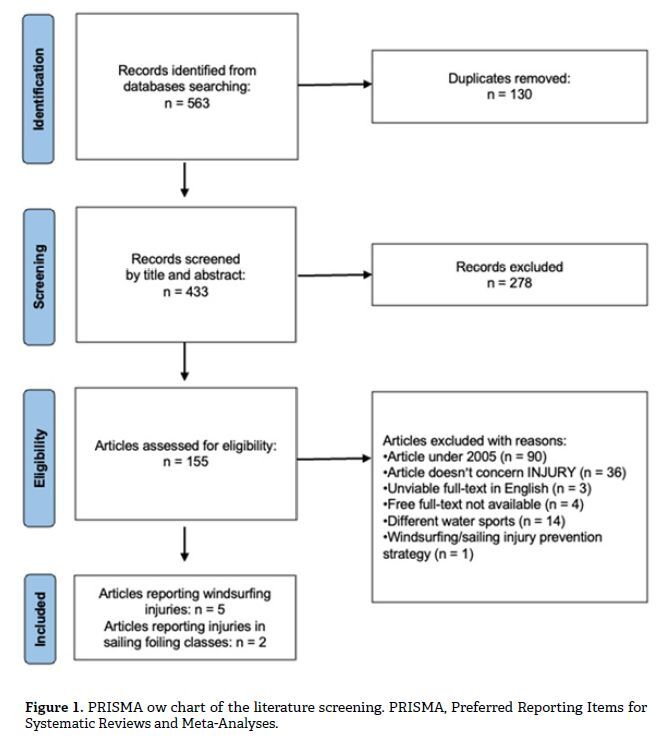
From 563 initially retrieved articles, seven studies were included. Injury definitions varied considerably and were applied inconsistently, with most studies relying on retrospective self-reported questionnaires of limited methodological quality. The lower extremities, shoulders, and lumbar spine were the most commonly affected anatomical regions. The incidence of injuries ranged from 1.5 injuries per athlete per year in traditional windsurfing to 7.0 injuries per 1000 hours in kitesurfing.
Conclusion:
Musculoskeletal injuries are common in windsurfing and related foiling sports, with distinct injury profiles between traditional displacement-based boards and hydrofoil-supported classes. The transition to iQFOiL is likely to shift the injury burden from overuse toward acute trauma, especially in the lower limbs. Given the lack of standardized definitions and prospective surveillance, the current evidence base is insufficient to establish robust risk models or targeted prevention strategies. Future research should implement longitudinal, standardized injury surveillance and develop evidence-based, sport-specific prevention programs tailored to the unique biomechanical demands of iQFOiL.
The purpose of this study was to systematically review the literature regarding injury definitions, localization, incidence in windsurfing and related sailing disciplines, with particular emphasis on implications for the new Olympic iQFOiL class.
Methods:
Three electronic databases – PubMed, Scopus and Web of Science – were searched for relevant studies up to 30 April 2025. Peer-reviewed articles in English assessing injury epidemiology in windsurfing, sailing, or hydrofoil-based classes were included. Studies were excluded if they were duplicates, inaccessible in full text, not related to sport disciplines, or lacking injury data.
Results:
From 563 initially retrieved articles, seven studies were included. Injury definitions varied considerably and were applied inconsistently, with most studies relying on retrospective self-reported questionnaires of limited methodological quality. The lower extremities, shoulders, and lumbar spine were the most commonly affected anatomical regions. The incidence of injuries ranged from 1.5 injuries per athlete per year in traditional windsurfing to 7.0 injuries per 1000 hours in kitesurfing.
Conclusion:
Musculoskeletal injuries are common in windsurfing and related foiling sports, with distinct injury profiles between traditional displacement-based boards and hydrofoil-supported classes. The transition to iQFOiL is likely to shift the injury burden from overuse toward acute trauma, especially in the lower limbs. Given the lack of standardized definitions and prospective surveillance, the current evidence base is insufficient to establish robust risk models or targeted prevention strategies. Future research should implement longitudinal, standardized injury surveillance and develop evidence-based, sport-specific prevention programs tailored to the unique biomechanical demands of iQFOiL.
| ISSN: | 2300-0767 |

We process personal data collected when visiting the website. The function of obtaining information about users and their behavior is carried out by voluntarily entered information in forms and saving cookies in end devices. Data, including cookies, are used to provide services, improve the user experience and to analyze the traffic in accordance with the Privacy policy. Data are also collected and processed by Google Analytics tool (more).
You can change cookies settings in your browser. Restricted use of cookies in the browser configuration may affect some functionalities of the website.
You can change cookies settings in your browser. Restricted use of cookies in the browser configuration may affect some functionalities of the website.