
PRACA PRZEGLĄDOWA
Exercise-Based Strategies to Enhance BDNF and Cognitive Recovery After Stroke: A Clinical Review
1
Collegium Medicum, University of Zielona Gora, Poland
2
Institute of Health Sciences, Collegium Medicum, University of Zielona Góra, Poland
3
Faculty of Medicine, Ludwik Rydygier Collegium Medicum in Bydgoszcz, Nicolaus Copernicus University in Toruń, Poland
Zaznaczeni autorzy mieli równy wkład w przygotowanie tego artykułu
Data nadesłania: 24-01-2026
Data ostatniej rewizji: 23-02-2026
Data akceptacji: 23-02-2026
Data publikacji online: 08-09-2026
Data publikacji: 08-09-2026
Autor do korespondencji
Bartłomiej J. Czyżniewski
Institute of Health Sciences, Collegium Medicum, University of Zielona Góra, Zyty 28, 65-046, Zielona Góra, Poland
Institute of Health Sciences, Collegium Medicum, University of Zielona Góra, Zyty 28, 65-046, Zielona Góra, Poland
Issue Rehabil. Orthop. Neurophysiol. Sport Promot. 2026;54(1):17-26

SŁOWA KLUCZOWE
DZIEDZINY
STRESZCZENIE
Introduction:
Stroke is one of the leading causes of death and long-term disability worldwide, with a growing number of survivors living with cognitive impairment. Aerobic exercise is recognised as a promising non-pharmacological intervention supporting neuroplasticity and functional recovery after stroke. Brain-derived neurotrophic factor (BDNF) plays a key role in activity-dependent plasticity and has been proposed as a potential biomarker of rehabilitation success; however, clinical evidence regarding exercise-induced changes in BDNF remains inconsistent.
Aim:
This clinical narrative review summarises clinical studies evaluating the effects of structured aerobic training on circulating BDNF levels and cognitive outcomes in stroke survivors.
Materials and methods:
A literature search identified five eligible clinical trials.
Results:
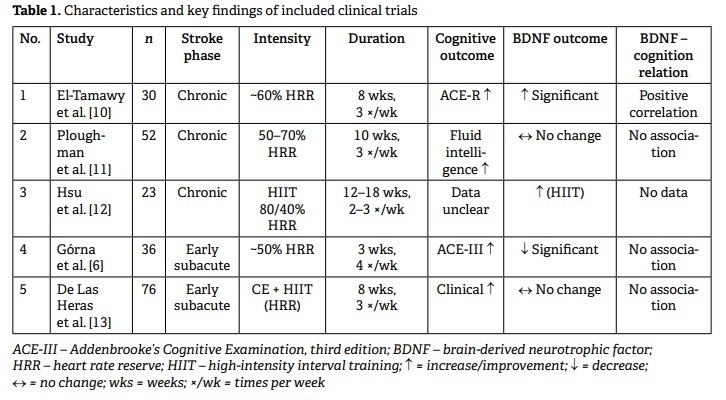
Across these studies, aerobic exercise interventions consistently improved cognitive performance or related functional outcomes. Moderate-intensity aerobic training, corresponding to approximately 50–60% of heart rate reserve, was associated with the most consistent cognitive benefits. In contrast, high-intensity exercise protocols were linked to increases in circulating BDNF concentrations but did not demonstrate clearly superior cognitive outcomes compared with moderate-intensity training. Chronic BDNF responses to aerobic training were heterogeneous. One study reported an increase in resting BDNF levels, two studies observed no significant change, one study reported a decrease, and one study demonstrated BDNF increases only following high-intensity interval training. In most trials, changes in circulating BDNF were not associated with improvements in cognitive or clinical outcomes.
Conclusions:
These findings indicate that aerobic exercise is an effective component of post-stroke rehabilitation aimed at improving cognitive function. However, resting circulating BDNF shows substantial variability and does not consistently reflect cognitive recovery, suggesting that BDNF alone is not a reliable long-term biomarker of exercise-induced cognitive improvement after stroke. Moderate-intensity aerobic training remains the most practical and clinically beneficial strategy.
Stroke is one of the leading causes of death and long-term disability worldwide, with a growing number of survivors living with cognitive impairment. Aerobic exercise is recognised as a promising non-pharmacological intervention supporting neuroplasticity and functional recovery after stroke. Brain-derived neurotrophic factor (BDNF) plays a key role in activity-dependent plasticity and has been proposed as a potential biomarker of rehabilitation success; however, clinical evidence regarding exercise-induced changes in BDNF remains inconsistent.
Aim:
This clinical narrative review summarises clinical studies evaluating the effects of structured aerobic training on circulating BDNF levels and cognitive outcomes in stroke survivors.
Materials and methods:
A literature search identified five eligible clinical trials.
Results:
Across these studies, aerobic exercise interventions consistently improved cognitive performance or related functional outcomes. Moderate-intensity aerobic training, corresponding to approximately 50–60% of heart rate reserve, was associated with the most consistent cognitive benefits. In contrast, high-intensity exercise protocols were linked to increases in circulating BDNF concentrations but did not demonstrate clearly superior cognitive outcomes compared with moderate-intensity training. Chronic BDNF responses to aerobic training were heterogeneous. One study reported an increase in resting BDNF levels, two studies observed no significant change, one study reported a decrease, and one study demonstrated BDNF increases only following high-intensity interval training. In most trials, changes in circulating BDNF were not associated with improvements in cognitive or clinical outcomes.
Conclusions:
These findings indicate that aerobic exercise is an effective component of post-stroke rehabilitation aimed at improving cognitive function. However, resting circulating BDNF shows substantial variability and does not consistently reflect cognitive recovery, suggesting that BDNF alone is not a reliable long-term biomarker of exercise-induced cognitive improvement after stroke. Moderate-intensity aerobic training remains the most practical and clinically beneficial strategy.
REFERENCJE (14)
1.
Feigin VL, Brainin M, Norrving B, et al. World Stroke Organization: global stroke fact sheet 2025. Int J Stroke 2025; 20: 132–144.
2.
Li W, Luo Z, Jiang J, Li K, Wu C. The effects of exercise intervention on cognition and motor function in stroke survivors: a systematic review and meta-analysis. Neurol Sci 2023; 44: 1891–1903.
3.
Hötting K, Röder B. Beneficial effects of physical exercise on neuroplasticity and cognition. Neurosci Biobehav Rev 2013; 37: 2243–2257.
4.
Dinoff A, Herrmann N, Swardfager W, Lanctôt KL. The effect of acute exercise on blood concentrations of brain-derived neurotrophic factor in healthy adults: a meta-analysis. Eur J Neurosci 2017; 46: 1635–1646.
5.
Ashcroft SK, Ironside DD, Johnson L, Kuys SS, Thompson-Butel AG. Effect of exercise on brain-derived neurotrophic factor in stroke survivors: a systematic review and meta-analysis. Stroke 2022; 53: 3706–3716.
6.
Górna S, Podgórski T, Kleka P, Domaszewska K. Effects of different intensities of endurance training on neurotrophin levels and functional and cognitive outcomes in post-ischaemic stroke adults: a randomised clinical trial. Int J Mol Sci 2025; 26: 2810. DOI: 10.3390/ijms26062810.
7.
Mioshi E, Dawson K, Mitchell J, Arnold R, Hodges JR. The Addenbrooke’s Cognitive Examination Revised (ACE-R): a brief cognitive test battery for dementia screening. Int J Geriatr Psychiatry 2006; 21: 1078–1085.
8.
Hsieh S, Schubert S, Hoon C, Mioshi E, Hodges JR. Validation of the Addenbrooke’s Cognitive Examination III in frontotemporal dementia and Alzheimer’s disease. Dement Geriatr Cogn Disord 2013; 36: 242–250.
9.
Raven J, Raven JC, Court JH. Manual for Raven’s progressive matrices and vocabulary scales. Oxford: Oxford Psychologists Press; 1998.
10.
El-Tamawy MS, Abd-Allah F, Ahmed SM, Darwish MH, Khalifa HA. Aerobic exercises enhance cognitive functions and brain-derived neurotrophic factor in ischemic stroke patients. NeuroRehabilitation 2014; 34: 209–213.
11.
Ploughman M, Eskes GA, Kelly LP, Austin MW, Glynn L, Corbett D. Synergistic benefits of combined aerobic and cognitive training on fluid intelligence and the role of IGF-1 in chronic stroke. Neurorehabil Neural Repair 2019; 33: 199–212.
12.
Hsu CC, Fu TC, Huang SC, Chen CP, Wang JS. Increased serum brain-derived neurotrophic factor with high-intensity interval training in stroke patients: a randomized controlled trial. Ann Phys Rehabil Med 2021; 64: 101385. DOI: 10.1016/j.rehab.2020.03.010.
13.
De Las Heras B, Rodrigues L, Cristini J, Hernández-Medrano I, Pérez-Sánchez JR, Ruiz-Muñoz M. Investigating the acute and chronic effects of cardiovascular exercise on brain-derived neurotrophic factor in early subacute stroke. Neurorehabil Neural Repair 2025; 39: 653–665.
14.
De Assis GG, Murawska-Ciałowicz E. Brain-derived neurotrophic factor and stroke: perspectives on exercise as a health care strategy. Hum Mov 2024; 25: 1–14. DOI: 10.5114/hm.2024.136050.
| ISSN: | 2300-0767 |

Przetwarzamy dane osobowe zbierane podczas odwiedzania serwisu. Realizacja funkcji pozyskiwania informacji o użytkownikach i ich zachowaniu odbywa się poprzez dobrowolnie wprowadzone w formularzach informacje oraz zapisywanie w urządzeniach końcowych plików cookies (tzw. ciasteczka). Dane, w tym pliki cookies, wykorzystywane są w celu realizacji usług, zapewnienia wygodnego korzystania ze strony oraz w celu monitorowania ruchu zgodnie z Polityką prywatności. Dane są także zbierane i przetwarzane przez narzędzie Google Analytics (więcej).
Możesz zmienić ustawienia cookies w swojej przeglądarce. Ograniczenie stosowania plików cookies w konfiguracji przeglądarki może wpłynąć na niektóre funkcjonalności dostępne na stronie.
Możesz zmienić ustawienia cookies w swojej przeglądarce. Ograniczenie stosowania plików cookies w konfiguracji przeglądarki może wpłynąć na niektóre funkcjonalności dostępne na stronie.