


ORIGINAL RESEARCH
MODIFICATIONS OF ARTHROMETRIC TEST WITH KT-1000 IN ASSESSING PATIENTS AFTER ACL INJURY

1
Department of Biomechanics, Academy of Physical Education in Katowice, Katowice, Poland
2
Private practice, Fizjoterapia Piotr Kotajny, Pszczyna, Poland
Submission date: 2025-05-19
Final revision date: 2025-06-06
Acceptance date: 2025-06-09
Publication date: 2025-11-26
Corresponding author
Bogdan Bacik
Department of Biomechanics, Academy of Physical Education in Katowice, ul.Mikołowska 72A, 40-065, Katowice, Poland
Department of Biomechanics, Academy of Physical Education in Katowice, ul.Mikołowska 72A, 40-065, Katowice, Poland
Issue Rehabil. Orthop. Neurophysiol. Sport Promot. 2025;50(1):7-13

KEYWORDS
TOPICS
ABSTRACT
Introduction:
The aim of this study was to validate the reliability of the KT-1000 modified arthrometer with hand-held dynamometer in active and passive condition of the knee joint stabilization. Performing the test in active conditions may give reliable information that can be used in patient follow-up with an injuried ACL.
Material and Methods:
Two groups was examined: 21 patients with diagnosed anterior cruciate ligament rupture and 16 healthy controls. The modification of the KT-1000 was done by adding a dynamometer to allow the therapist to measure the strength used in the arthrometric test. The difference in the results was also evaluated according to the measurement conditions.
Results:
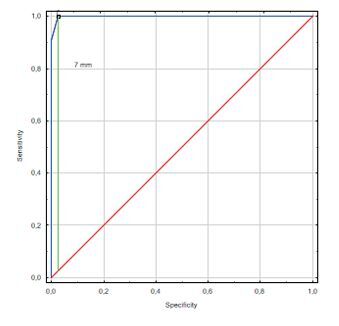
Intraclass correlation coefficient (ICC) was performed to examine the reliability of measurements and passive ICC values were 0.97 and ICC = 0.89 under active conditions. Significant differences in the parameters tested in passive conditions also allowed for the determination of ROC curves with reliable cut-off points for both translation and stiffness coefficient.
Discussion:
Modification of the KT-1000 with hand-held dynamometer allowed to obtained data to allow for joint stiffness to be observed which could provide opportunities for monitoring the influence of different forms of therapy on the mechanism of active knee stabilization
Conclusion:
The KT-1000 hand-held dynamometer modification is a sensitive tool for diagnosing knee instability and may be an alternative device in clinical practice. Also, a change in the condition of testing sagittal knee translation in the form of active muscle stabilization results in significantly differential outcomes.
The aim of this study was to validate the reliability of the KT-1000 modified arthrometer with hand-held dynamometer in active and passive condition of the knee joint stabilization. Performing the test in active conditions may give reliable information that can be used in patient follow-up with an injuried ACL.
Material and Methods:
Two groups was examined: 21 patients with diagnosed anterior cruciate ligament rupture and 16 healthy controls. The modification of the KT-1000 was done by adding a dynamometer to allow the therapist to measure the strength used in the arthrometric test. The difference in the results was also evaluated according to the measurement conditions.
Results:
Intraclass correlation coefficient (ICC) was performed to examine the reliability of measurements and passive ICC values were 0.97 and ICC = 0.89 under active conditions. Significant differences in the parameters tested in passive conditions also allowed for the determination of ROC curves with reliable cut-off points for both translation and stiffness coefficient.
Discussion:
Modification of the KT-1000 with hand-held dynamometer allowed to obtained data to allow for joint stiffness to be observed which could provide opportunities for monitoring the influence of different forms of therapy on the mechanism of active knee stabilization
Conclusion:
The KT-1000 hand-held dynamometer modification is a sensitive tool for diagnosing knee instability and may be an alternative device in clinical practice. Also, a change in the condition of testing sagittal knee translation in the form of active muscle stabilization results in significantly differential outcomes.
| ISSN: | 2300-0767 |

We process personal data collected when visiting the website. The function of obtaining information about users and their behavior is carried out by voluntarily entered information in forms and saving cookies in end devices. Data, including cookies, are used to provide services, improve the user experience and to analyze the traffic in accordance with the Privacy policy. Data are also collected and processed by Google Analytics tool (more).
You can change cookies settings in your browser. Restricted use of cookies in the browser configuration may affect some functionalities of the website.
You can change cookies settings in your browser. Restricted use of cookies in the browser configuration may affect some functionalities of the website.