


REVIEW ARTICLE
Brain-computer interfaces usage in neurorehabilitation of patients after stroke – systematic review
1
Student Scientific Association of Neurology, Wroclaw Medical University, Poland
2
Faculty of Fundamental Problems of Technology, Department of Biomedical Engineering, Wroclaw University of Science and Technology, Poland
3
Faculty of Information and Communication Technology, Wroclaw University of Science and Technology, Poland
4
Department of Neurology, University Center of Neurology and Neurosurgery, Wroclaw Medical University, Poland
Submission date: 2025-11-30
Final revision date: 2026-02-24
Acceptance date: 2026-02-25
Publication date: 2026-09-23
Corresponding author
Sylwiusz Kontek
Student Scientific Association of Neurology, Wroclaw Medical University, Wrocław, Poland
Student Scientific Association of Neurology, Wroclaw Medical University, Wrocław, Poland
Issue Rehabil. Orthop. Neurophysiol. Sport Promot. 2026;54(1):41-54

KEYWORDS
TOPICS
ABSTRACT
Introduction:
Stroke is a leading cause of long-term disability worldwide, necessitating effective rehabilitation strategies. Currently, neurofeedback and brain-computer interfaces (BCI) based on electroencephalography (EEG) provide promising tools for controlled and precise neurorehabilitation.
Aim:
To assess the therapeutic efficacy of EEG-based BCI usage in the neurorehabilitation process of post-stroke patients. The assessment focuses on the impact of motor functions and the induction of neuroplasticity.
Materials and methods:
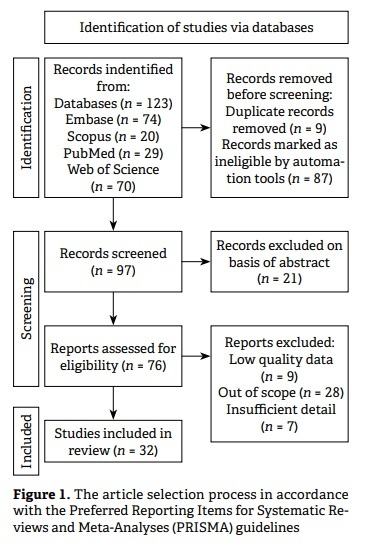
A systematic review was conducted in accordance with the Preferred Reporting Items for Systematic Reviews and Meta-Analyses (PRISMA) guidelines. A comprehensive literature search across five major databases resulted in the final inclusion of 32 articles.
Results:
Analysis revealed a diversity of BCI modalities, primarily utilizing motor imagery combined with virtual reality, functional electrical stimulation, and robotic exoskeletons to close the sensorimotor loop. Procedural parameters varied significantly: session durations ranged from brief tasks to one-hour protocols. The total number of sessions are also varied widely, from pilot studies to extended regimens of up to 80 sessions, averaging approximately 30 sessions. Regarding signal acquisition, most studies utilized high-density EEG setups (typically 20 or 32 leads). The cohorts predominantly included patients with chronic ischemic stroke, although healthy individuals were often recruited for system validation. Therapeutic effects were confirmed by significant improvements in clinical scales, particularly the Fugl-Meyer Assessment and neurophysiological markers, such as suppression of the mu rhythm.
Conclusions:
Evidence supports that BCI-related methods significantly improve clinical outcomes in stroke survivors. However, the extent of positive neurological impact depends on the specific BCI modality and stroke characteristics. Future research requires standardized protocols to optimize dosage and include underrepresented patient groups.
Stroke is a leading cause of long-term disability worldwide, necessitating effective rehabilitation strategies. Currently, neurofeedback and brain-computer interfaces (BCI) based on electroencephalography (EEG) provide promising tools for controlled and precise neurorehabilitation.
Aim:
To assess the therapeutic efficacy of EEG-based BCI usage in the neurorehabilitation process of post-stroke patients. The assessment focuses on the impact of motor functions and the induction of neuroplasticity.
Materials and methods:
A systematic review was conducted in accordance with the Preferred Reporting Items for Systematic Reviews and Meta-Analyses (PRISMA) guidelines. A comprehensive literature search across five major databases resulted in the final inclusion of 32 articles.
Results:
Analysis revealed a diversity of BCI modalities, primarily utilizing motor imagery combined with virtual reality, functional electrical stimulation, and robotic exoskeletons to close the sensorimotor loop. Procedural parameters varied significantly: session durations ranged from brief tasks to one-hour protocols. The total number of sessions are also varied widely, from pilot studies to extended regimens of up to 80 sessions, averaging approximately 30 sessions. Regarding signal acquisition, most studies utilized high-density EEG setups (typically 20 or 32 leads). The cohorts predominantly included patients with chronic ischemic stroke, although healthy individuals were often recruited for system validation. Therapeutic effects were confirmed by significant improvements in clinical scales, particularly the Fugl-Meyer Assessment and neurophysiological markers, such as suppression of the mu rhythm.
Conclusions:
Evidence supports that BCI-related methods significantly improve clinical outcomes in stroke survivors. However, the extent of positive neurological impact depends on the specific BCI modality and stroke characteristics. Future research requires standardized protocols to optimize dosage and include underrepresented patient groups.
REFERENCES (44)
1.
Feigin VL, Brainin M, Norrving B, et al. World Stroke Organization: global stroke fact sheet 2025. Int J Stroke 2025; 20: 132–144.
2.
Siger A, Dłużyński W, Gierczyński J, et al. Sytuacja chorych po udarze mózgu w Polsce. Raport 2024. The situation of stroke patients in Poland. Report 2024. DOI: 10.13140/RG.2.2.32595.80167.
3.
Cioffi E, Hutber A, Molloy R, et al. EEG-based sensorimotor neurofeedback for motor neurorehabilitation in children and adults: a scoping review. Clin Neurophysiol 2024; 167: 143–166.
4.
Page MJ, McKenzie JE, Bossuyt PM, et al. The PRISMA 2020 statement: an updated guideline for reporting systematic reviews. BMJ 2021; 372: n71. DOI: 10.1136/bmj.n71.
5.
Kim MS, Park H, Kwon I, et al. Efficacy of brain-computer interface training with motor imagery-contingent feedback in improving upper limb function and neuroplasticity among persons with chronic stroke: a double-blinded, parallel-group, randomized controlled trial. J Neuroeng Rehabil 2025; 22: 1. DOI: 10.1186/s12984-024-01535-2.
6.
Butet S, Fleury M, Duché Q, et al. EEG-fMRI neurofeedback versus motor imagery after stroke, a randomized controlled trial. J Neuroeng Rehabil 2025; 22: 67. DOI: 10.1186/s12984-025-01598-9.
7.
Cha S, Kim KT, Chang WK, et al. Effect of electroencephalography-based motor imagery neurofeedback on mu suppression during motor attempt in patients with stroke. J Neuroeng Rehabil 2025; 22: 119. DOI: 10.1186/s12984-025-01653-5.
8.
Muller CO, Prampart T, Bannier E, Corouge I, Maurel P. Evaluating the effects of multimodal EEG-fNIRS neurofeedback for motor imagery: an experimental platform and study protocol. PLOS One 2025; 20: e0331177. DOI: 10.1371/journal.pone.0331177.
9.
Yuan Z, Peng Y, Wang L, et al. Effect of BCI-controlled pedaling training system with multiple modalities of feedback on motor and cognitive function rehabilitation of early subacute stroke patients. IEEE Trans Neural Syst Rehabil Eng 2021; 29: 2569–2577.
10.
Kern K, Vukelić M, Guggenberger R, Gharabaghi A. Oscillatory neurofeedback networks and poststroke rehabilitative potential in severely impaired stroke patients. Neuroimage Clin 2023; 37: 103289. DOI: 10.1016/j.nicl.2022.103289. .
11.
Afonso M, Sánchez-Cuesta F, González-Zamorano Y, Pablo Romero J, Vourvopoulos A. Investigating the synergistic neuromodulation effect of bilateral rTMS and VR brain-computer interfaces training in chronic stroke patients. J Neural Eng 2024; 21. DOI: 10.1088/1741-2552/ad8836.
12.
Kim MS, Park H, Kwon I, An KO, Shin JH. Brain-computer interface on wrist training with or without neurofeedback in subacute stroke: a study protocol for a double-blinded,randomized control pilot trial. Front Neurol. 2024; 15: 1376782. DOI: 10.3389/fneur.2024.1376782.
13.
Lin M, Huang J, Fu J, Sun Y, Fang Q. A VR-based motor imagery training system with EMG-based real-time feedback for post-stroke rehabilitation. IEEE Trans Neural Syst Rehabil Eng 2023; 31: 1–10.
14.
Phang CR, Chen CH, Cheng YY, Chen YJ, Ko LW. Frontoparietal dysconnection in covert bipedal activity for enhancing the performance of the motor preparation-based brain-computer interface. IEEE Trans Neural Syst Rehabil Eng 2023; 31: 139–149.
15.
Remsik AB, van Kan PLE, Gloe S, et al. BCI-FES with multimodal feedback for motor recovery poststroke. Front Hum Neurosci 2022; 16: 725715. DOI: 10.3389/fnhum.2022.725715.
16.
Mak J, Kocanaogullari D, Huang X, et al. Detection of stroke-induced visual neglect and target response prediction using augmented reality and electroencephalography. IEEE Trans Neural Syst Rehabil Eng 2022; 30: 1840–1850.
17.
Gangadharan SK, Ramakrishnan S, Paek A, Ravindran A, Prasad VA, Vidal JLC. Characterization of event related desynchronization in chronic stroke using motor imagery based brain computer interface for upper limb rehabilitation. Ann Indian Acad Neurol 2024; 27: 297–306.
18.
Li X, Wang L, Miao S, et al. Sensorimotor rhythm-brain computer interface with audiocue, motor observation and multisensory feedback for upper-limb stroke rehabilitation: a controlled study. Front Neurosci 2022; 16: 808830. DOI: 10.3389/fnins.2022.808830. .
19.
Mayorova L, Kushnir A, Sorokina V, et al. Rapid effects of BCI-based attention training on functional brain connectivity in poststroke patients: a pilot resting-state fMRI study. Neurol Int 2023; 15: 549–559.
20.
Lakshminarayanan K, Ramu V, Shah R, et al. Developing a tablet-based brain-computer interface and robotic prototype for upper limb rehabilitation. PeerJ Comput Sci 2024; 10: e2174. DOI: 10.7717/peerj-cs.2174.
21.
Yue Z, Xiao P, Wang J, Tong RK. Brain oscillations in reflecting motor status and recovery induced by action observation-driven robotic hand intervention in chronic stroke. Front Neurosci 2023; 17. 1241772. DOI: 10.3389/fnins.2023.1241772.
22.
Cantillo-Negrete J, Carino-Escobar RI, Carrillo-Mora P, et al. Brain-computer interface coupled to a robotic hand orthosis for stroke patients’ neurorehabilitation: a crossover feasibility study. Front Hum Neurosci 2021; 15: 656975. DOI: 10.3389/fnhum.2021.656975.
23.
Carino-Escobar RI, Rodríguez-García ME, Carrillo-Mora P, Valdés-Cristerna R, Cantillo-Negrete J. Continuous versus discrete robotic feedback for brain-computer interfaces aimed for neurorehabilitation. Front Neurorobot 2023; 17: 1015464. DOI: 10.3389/fnbot.2023.1015464.
24.
Zhang X, Xie L, Liu W, et al. Exoskeleton-guided passive movement elicits standardized EEG patterns for generalizable BCIs in stroke rehabilitation. J Neuroeng Rehabil 2025; 22: 97. DOI: 10.1186/s12984-025-01627-7.
25.
Wang Y, Luo J, Guo Y, Du Q, Cheng Q, Wang H. Changes in EEG brain connectivity caused by short-term BCI neurofeedback-rehabilitation training: a case study. Front Hum Neurosci 2021; 15: 627100. DOI: 10.3389/fnhum.2021.627100.
26.
Zhang W, Wang T, Qin C, et al. Vibration stimulation enhances robustness in teleoperation robot system with EEG and eye-tracking hybrid control. Front Bioeng Biotechnol 2025; 13: 1591316. DOI: 10.3389/fbioe.2025.1591316.
27.
Lee M, Jeong JH, Kim YH, Lee SW. Decoding finger tapping with the affected hand in chronic stroke patients during motor imagery and execution. IEEE Trans Neural Syst Rehabil Eng 2021; 29: 1099–1109.
28.
Winter L, Huang Q, Sertic JVL, Konczak J. The effectiveness of proprioceptive training for improving motor performance and motor dysfunction: a systematic review. Front Rehabil Sci 2022; 3: 830166. DOI: 10.3389/fresc.2022.830166.
29.
Dickstein R, Deutsch JE. Motor imagery in physical therapist practice. Phys Ther 2007; 87: 942–953.
30.
Machado TC, Carregosa AA, Santos MS, Ribeiro NM da S, Melo A. Efficacy of motor imagery additional to motor-based therapy in the recovery of motor function of the upper limb in post-stroke individuals: a systematic review. Top Stroke Rehabil 2019; 26: 548–553.
31.
Wang H, Xu G, Wang X, et al. The reorganization of resting-state brain networks associated with motor imagery training in chronic stroke patients. IEEE Trans Neural Syst Rehabil Eng 2019; 27: 2237–2245.
32.
Christakou A, Bouzineki C, Pavlou M, Stran-jalis G, Sakellari V. The effectiveness of motor imagery in balance and functional status of older people with early-stage dementia. Brain Sci 2024; 14: 1151. doi: 10.3390/brainsci14111151.
33.
Hilt PM, Bertrand MF, Féasson L, et al. Motor imagery training is beneficial for motor memory of upper and lower limb tasks in very old adults. Int J Environ Res Public Health 2023; 20: 3541. DOI: 10.3390/ijerph20043541.
34.
Celnik P, Webster B, Glasser DM, Cohen LG. Effects of action observation on physical training after stroke. Stroke 2008; 39: 1814–1820.
35.
Kim T, Frank C, Schack T. A systematic investigation of the effect of action observation training and motor imagery training on the development of mental representation structure and skill performance. Front Hum Neurosci 2017; 11: 499. DOI: 10.3389/fnhum.2017.00499.
36.
Khan MA, Das R, Iversen HK, Puthusserypady S. Review on motor imagery based BCI systems for upper limb post-stroke neurorehabilitation: from designing to application. Comput Biol Med 2020; 123: 103843. DOI: 10.1016/j.compbiomed.2020.103843.
37.
Khruscheva N, Melnikov M, Bezmaternykh D, et al. Interactive brain stimulation neurotherapy based on BOLD signal in stroke rehabilitation. NeuroRegulation 2022; 9: 147. DOI: 10.15540/nr.9.3.147.
38.
Ma Y, Karako K, Song P, Hu X, Xia Y. Integrative neurorehabilitation using brain-computer interface: from motor function to mental health after stroke. BioScience Trends 2025; 19: 243-251.
39.
Seghier ML. Laterality index in functional MRI: methodological issues. Magn Reson Imaging 2008; 26: 594–601.
40.
Kim YK, Park E, Lee A, Im CH, Kim YH. Changes in network connectivity during motor imagery and execution. PLoS One 2018; 13: e0190715. DOI: 10.1371/journal.pone.0190715.
41.
Hurst AJ, Boe SG. Imagining the way forward: a review of contemporary motor imagery theory. Front Hum Neurosci 2022; 16: 1033493. DOI: 10.3389/fnhum.2022.1033493.
42.
Villa-Berges E, Laborda Soriano AA, Lucha-López O, et al. Motor imagery and mental practice in the subacute and chronic phases in upper limb rehabilitation after stroke: a systematic review. Occup Ther Int 2023; 2023: 3752889. DOI: 10.1155/2023/3752889.
43.
Jiang Y, Jessee W, Hoyng S, et al. Sharpening working memory with real-time electrophysiological brain signals: which neurofeedback paradigms work? Front Aging Neurosci 2022; 14: 780817. DOI: 10.3389/fnagi.2022.780817.
44.
Iadarola G, Mengarelli A, Iarlori S, Monteriù A, Spinsante S. RGB-D cameras and brain-computer interfaces for human activity recognition: an overview. Sensors 2025; 25: 6286. DOI: 10.3390/s25206286.
Share
RELATED ARTICLE
| ISSN: | 2300-0767 |

We process personal data collected when visiting the website. The function of obtaining information about users and their behavior is carried out by voluntarily entered information in forms and saving cookies in end devices. Data, including cookies, are used to provide services, improve the user experience and to analyze the traffic in accordance with the Privacy policy. Data are also collected and processed by Google Analytics tool (more).
You can change cookies settings in your browser. Restricted use of cookies in the browser configuration may affect some functionalities of the website.
You can change cookies settings in your browser. Restricted use of cookies in the browser configuration may affect some functionalities of the website.