


PRACA ORYGINALNA
Porównanie uciskowego progu bólowego u osób z wysokim oraz niskim poziomem aktywności fizycznej
1
Department of Physiotherapy, Poznan University of Medical Sciences, Poznan, Poland
Data nadesłania: 25-11-2025
Data ostatniej rewizji: 11-01-2026
Data akceptacji: 12-01-2026
Data publikacji online: 15-05-2026
Data publikacji: 02-07-2026
Autor do korespondencji
Marta Wiśniewska
Department of Physiotherapy, Poznan University of Medical Sciences, 32/2 Saperska St., 61-493 Poznan, Poland
Department of Physiotherapy, Poznan University of Medical Sciences, 32/2 Saperska St., 61-493 Poznan, Poland
Issue Rehabil. Orthop. Neurophysiol. Sport Promot. 2025;53(4):23-33

SŁOWA KLUCZOWE
DZIEDZINY
STRESZCZENIE
Wstęp:
Wpływ aktywności fizycznej na odczuwanie bólu był wielokrotnie analizowany w piśmiennictwie naukowym, jednak zróżnicowanie populacji badanych oraz stosowanych metod pomiaru utrudnia osiągnięcie jednoznacznych wniosków.
Cel:
Celem niniejszego badania była ocena wpływu poziomu aktywności fizycznej na wartości uciskowego progu bólowego (PPT), z uwzględnieniem intensywności i czasu trwania treningu oraz płci.
Materiał i metody:
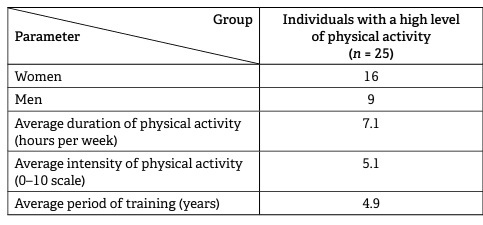
Do badania włączono 53 osoby, które na podstawie wyników ankiety przypisano do grup o wysokim lub niskim poziomie aktywności fizycznej. Uczestnikom zbadano PPT w czterech punktach po prawej stronie ciała: w obrębie mięśnia nadgrzebieniowego, nadkłykcia bocznego kości ramiennej, okolicy pośladkowej oraz przyśrodkowej kolana. Na tej podstawie wyznaczono wartości PPT dla kończyny górnej i dolnej.
Wyniki:
Wyniki wykazały istotnie wyższe wartości PPT kończyny górnej w grupie o wysokim poziomie aktywności fizycznej w porównaniu z grupą o niskim poziomie aktywności. Zaobserwowano również istotnie wyższy PPT kończyny dolnej u mężczyzn niż u kobiet. Ponadto stwierdzono słabą dodatnią korelację pomiędzy średnim czasem aktywności fizycznej a wartościami PPT kończyny górnej, średnią intensywnością treningu a wartościami PPT kończyny górnej oraz średnim czasem aktywności fizycznej a wartościami PPT kończyny dolnej. Dłuższy okres regularnej aktywności fizycznej okazał się istotnym czynnikiem predykcyjnym niższego PPT w kończynie dolnej.
Wnioski:
Uzyskane wyniki sugerują, że wyższy poziom aktywności fizycznej może wiązać się z podwyższonym PPT, a na odczuwanie bólu mogą wpływać również intensywność i czas trwania treningów, długość utrzymywania aktywności fizycznej oraz płeć. Z uwagi na złożoność zjawiska konieczne są dalsze badania w celu pełniejszego zrozumienia tych zależności.
Wpływ aktywności fizycznej na odczuwanie bólu był wielokrotnie analizowany w piśmiennictwie naukowym, jednak zróżnicowanie populacji badanych oraz stosowanych metod pomiaru utrudnia osiągnięcie jednoznacznych wniosków.
Cel:
Celem niniejszego badania była ocena wpływu poziomu aktywności fizycznej na wartości uciskowego progu bólowego (PPT), z uwzględnieniem intensywności i czasu trwania treningu oraz płci.
Materiał i metody:
Do badania włączono 53 osoby, które na podstawie wyników ankiety przypisano do grup o wysokim lub niskim poziomie aktywności fizycznej. Uczestnikom zbadano PPT w czterech punktach po prawej stronie ciała: w obrębie mięśnia nadgrzebieniowego, nadkłykcia bocznego kości ramiennej, okolicy pośladkowej oraz przyśrodkowej kolana. Na tej podstawie wyznaczono wartości PPT dla kończyny górnej i dolnej.
Wyniki:
Wyniki wykazały istotnie wyższe wartości PPT kończyny górnej w grupie o wysokim poziomie aktywności fizycznej w porównaniu z grupą o niskim poziomie aktywności. Zaobserwowano również istotnie wyższy PPT kończyny dolnej u mężczyzn niż u kobiet. Ponadto stwierdzono słabą dodatnią korelację pomiędzy średnim czasem aktywności fizycznej a wartościami PPT kończyny górnej, średnią intensywnością treningu a wartościami PPT kończyny górnej oraz średnim czasem aktywności fizycznej a wartościami PPT kończyny dolnej. Dłuższy okres regularnej aktywności fizycznej okazał się istotnym czynnikiem predykcyjnym niższego PPT w kończynie dolnej.
Wnioski:
Uzyskane wyniki sugerują, że wyższy poziom aktywności fizycznej może wiązać się z podwyższonym PPT, a na odczuwanie bólu mogą wpływać również intensywność i czas trwania treningów, długość utrzymywania aktywności fizycznej oraz płeć. Z uwagi na złożoność zjawiska konieczne są dalsze badania w celu pełniejszego zrozumienia tych zależności.
REFERENCJE (34)
1.
International Association for the Study of Pain Subcommittee on Taxonomy. Pain terms: a list with definitions and notes on usage. Recommended by the IASP Subcommittee on Taxonomy. Pain 1979; 6: 249.
2.
Raja SN, Carr DB, Cohen M, et al. The revised International Association for the Study of Pain definition of pain: concepts, challenges, and compromises. Pain 2020; 161: 1976–1982.
3.
Bhattacharyya A, Hopkinson LD, Nolet PS, Srbely J. The reliability of pressure pain threshold in individuals with low back or neck pain: a systematic review. Br J Pain 2023; 17: 579–591.
4.
Potter L, McCarthy C, Oldham J. Algometer reliability in measuring pain pressure threshold over normal spinal muscles to allow quantification of anti-nociceptive treatment. Int J Osteopath Med 2006; 9: 113–119.
5.
Chesterton LS, Sim J, Wright CC, Foster NE. Interrater reliability of algometry in measuring pressure pain thresholds in healthy humans, using multiple raters. Clin J Pain 2007; 23: 760–766.
6.
Walton DM, Macdermid JC, Nielson W, et al. Reliability, standard error, and minimum detectable change of clinical pressure pain threshold testing in people with and without acute neck pain. J Orthop Sports Phys Ther 2011; 41: 644–650.
7.
Zamani S, Okhovatian F, Naimi SS, et al. Intra-examiner and between-day reliability of algometer for pressure pain threshold and pain sensitivity in upper trapezius muscle in asymptomatic young adult women. J Clin Physiother Res 2017; 2: 15–20.
8.
Vanderweeën L, Oostendorp RA, Vaes P, Du-quet W. Pressure algometry in manual therapy. Man Ther 1996; 1: 258–265.
9.
Sumizono M, Sakakima H, Otsuka S, et al. The effect of exercise frequency on neuropathic pain and pain-related cellular reactions in the spinal cord and midbrain in a rat sciatic nerve injury model. J Pain Res 2018; 11: 281–291.
10.
Ray CA, Carter JR. Central modulation of exercise-induced muscle pain in humans. J Physiol 2007; 585: 287–294.
11.
Nijs J, Kosek E, Van Oosterwijck J, Meeus M. Dysfunctional endogenous analgesia during exercise in patients with chronic pain: to exercise or not to exercise? Pain Physician 2012; 15: ES205–ES213.
12.
Abdelmohsen AM, Nabil Abd El-Maboud BA. Impact of a targeted 8-week exercise program on pain measures and isokinetic muscle strength in females with patellofemoral pain syndrome: a randomized controlled trial. Physiother Res Int 2025; 30: e70093. DOI: 10.1002/pri.70093.
13.
Santos PJ, Aragão-Santos JC, Santos TS, et al. Effects of 2 training protocols on aspects of pain in older women with chronic low back pain: a randomized clinical trial. J Manipulative Physiol Ther 2025; 48: 47–56.
14.
González-Álvarez ME, Riquelme-Aguado V, Rossettini G, et al. Exercise intervention in women with fibromyalgia and its influence on pain, psychological variables, and disability: an observational study. Life (Basel) 2024; 15: 40. DOI: 10.3390/life15010040.
15.
Tesarz J, Schuster AK, Hartmann M, et al. Pain perception in athletes compared to normally active controls: a systematic review with meta-analysis. Pain 2012; 153: 1253–1262.
16.
Meeus M, Nijs J. Central sensitization: a biopsychosocial explanation for chronic widespread pain in patients with fibromyalgia and chronic fatigue syndrome. Clin Rheumatol 2007; 26: 465–473.
17.
Treede RD, Rief W, Barke A, et al. Chronic pain as a symptom or a disease: the IASP classification of chronic pain for the International Classification of Diseases (ICD-11). Pain 2019; 160: 19–27.
18.
World Health Organization. WHO guidelines on physical activity and sedentary behaviour. Geneva: WHO; 2020.
19.
Wolfe F, Smythe HA, Yunus MB, et al. The American College of Rheumatology 1990 criteria for the classification of fibromyalgia. Report of the multicenter criteria committee. Arthritis Rheum 1990; 33: 160–172.
20.
Ayadh M, Guillermin A, Abellan MA, et al. The assessment of natural human skin tension orientation and its variation according to age for two body areas: forearm and thigh. J Mech Behav Biomed Mater 2023; 141: 105798. DOI: 10.1016/j.jmbbm.2023.105798.
21.
Kasch H, Stengaard-Pedersen K, Arendt-Nielsen L, Staehelin Jensen T. Pain thresholds and tenderness in neck and head following acute whiplash injury: a prospective study. Cephalalgia 2001; 21: 189–197.
22.
Fleckenstein J, Simon P, König M, et al. The pain threshold of high-threshold mechanosensitive receptors subsequent to maximal eccentric exercise is a potential marker in the prediction of DOMS associated impairment. PLoS One 2017; 12: e0185463. DOI: 10.1371/journal.pone.0185463.
23.
Jones MD, Booth J, Taylor JL, Barry BK. Aerobic training increases pain tolerance in healthy individuals. Med Sci Sports Exerc 2014; 46: 1640–1647.
24.
Incel NA, Erdem HR, Ozgocmen S, et al. Pain pressure threshold values in ankylosing spondylitis. Rheumatol Int 2002; 22: 148–150.
25.
Knapstad MK, Nordahl SHG, Naterstad IF, et al. Measuring pressure pain threshold in the cervical region of dizzy patients – the reliability of a pressure algometer. Physiother Res Int 2018; 23: e1736. DOI: 10.1002/pri.1736.
26.
Maquet D, Croisier JL, Demoulin C, Crielaard JM. Pressure pain thresholds of tender point sites in patients with fibromyalgia and in healthy controls. Eur J Pain 2004; 8: 111–117.
27.
Hakansson S, Jones MD, Ristov M, et al. Intensity-dependent effects of aerobic training on pressure pain threshold in overweight men: a randomized trial. Eur J Pain 2018; 22: 1813–1823.
28.
Chesterton LS, Barlas P, Foster NE, et al. Gender differences in pressure pain threshold in healthy humans. Pain 2003; 101: 259–266.
29.
Anders M, Dreismickenbecker E, Fleckenstein J, et al. EEG-based sensory testing reveals altered nociceptive processing in elite endurance athletes. Exp Brain Res 2023; 241: 341–354.
30.
Sluka KA, Frey-Law L, Hoeger Bement M. Exercise-induced pain and analgesia? Underlying mechanisms and clinical translation. Pain 2018; 159: S91–S97. DOI: 10.1097/j.pain.0000000000001235.
31.
Vaegter HB, Jones MD. Exercise-induced hypoalgesia after acute and regular exercise: experimental and clinical manifestations and possible mechanisms in individuals with and without pain. Pain Rep 2020; 5: e823. DOI: 10.1097/PR9.0000000000000823.
32.
Fillingim RB. Individual differences in pain: understanding the mosaic that makes pain personal. Pain 2017; 158: S11–S18. DOI: 10.1097/j.pain.0000000000000775.
33.
Hennings A, Schwarz MJ, Riemer S, et al. The influence of physical activity on pain thresholds in patients with depression and multiple somatoform symptoms. Clin J Pain 2012; 28: 782–789.
34.
Nakae A, Bu-Omer HM, Kishimoto C, et al. Personality and its influence on pain sensitivity based on different hormonal responses to individual vs. group exercise styles. Life (Basel) 2025; 15: 222. DOI: 10.3390/life15020222.
| ISSN: | 2300-0767 |

Przetwarzamy dane osobowe zbierane podczas odwiedzania serwisu. Realizacja funkcji pozyskiwania informacji o użytkownikach i ich zachowaniu odbywa się poprzez dobrowolnie wprowadzone w formularzach informacje oraz zapisywanie w urządzeniach końcowych plików cookies (tzw. ciasteczka). Dane, w tym pliki cookies, wykorzystywane są w celu realizacji usług, zapewnienia wygodnego korzystania ze strony oraz w celu monitorowania ruchu zgodnie z Polityką prywatności. Dane są także zbierane i przetwarzane przez narzędzie Google Analytics (więcej).
Możesz zmienić ustawienia cookies w swojej przeglądarce. Ograniczenie stosowania plików cookies w konfiguracji przeglądarki może wpłynąć na niektóre funkcjonalności dostępne na stronie.
Możesz zmienić ustawienia cookies w swojej przeglądarce. Ograniczenie stosowania plików cookies w konfiguracji przeglądarki może wpłynąć na niektóre funkcjonalności dostępne na stronie.
