


REVIEW ARTICLE
Lateral Wedge Insoles in Knee Osteoarthritis: A Post-EULAR 2023 Review of Biomechanical and Clinical Outcomes
1
Data Analysis, KKS Statistics, Ruda Śląska, Poland
2
Medical Internship, St. Barbara Regional Specialist Hospital in Sosnowiec, Poland
3
Medical Internship, Regional Specialist Hospital of the Blessed Virgin Mary in Częstochowa, Poland
4
Medical Internship, Regional Hospital in Poznań – Greater Poland Specialist Centre, Poland
5
Medical Internship, District Hospital in Zawiercie, Poland
6
Medical Internship, Pope John Paul II Regional Hospital in Zamość, Poland
Submission date: 2026-04-04
Final revision date: 2026-07-05
Acceptance date: 2026-08-18
Online publication date: 2026-09-08
Publication date: 2026-09-08
Issue Rehabil. Orthop. Neurophysiol. Sport Promot. 2026;54(1):1-16

KEYWORDS
TOPICS
ABSTRACT
Introduction:
Knee osteoarthritis is a chronic condition leading to pain, functional limitations, and structural joint changes. Non-surgical management includes patient education, exercise therapy, and weight reduction. The use of lateral wedge insoles (LWIs) remains controversial, and current evidence regarding their effectiveness is inconclusive.
Aim:
This review aimed to examine recent studies published after the 2023 European Alliance of Associations for Rheumatology (EULAR) guidelines on the use of LWIs in the management of knee osteoarthritis (KOA), with particular emphasis on their effects on joint biomechanics and clinical outcomes.
Materials and methods:
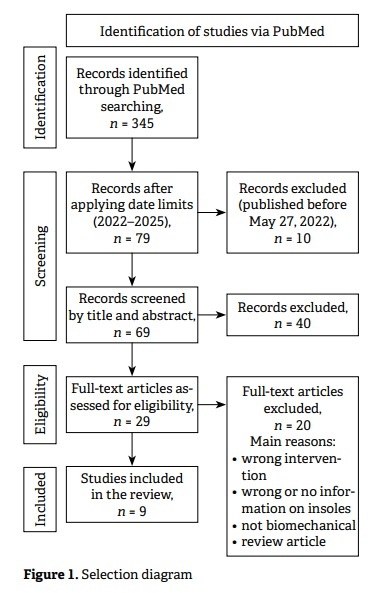
A targeted search was conducted in PubMed for publications from May 2022 to 2025 related to KOA and LWIs. Nine studies were included in the analysis: five randomized controlled trials, one network meta-analysis, two experimental studies, and one non-randomized clinical-control study. Biomechanical outcomes (knee adduction moment, tibial rotation, center of pressure displacement) and clinical outcomes (pain and joint function) were evaluated.
Results:
Some studies reported beneficial effects of LWIs on biomechanical parameters and subjective pain perception, including improved gait comfort, reduced lateral knee displacement, and decreased pain. Other studies found no significant clinical effects, and observed biomechanical changes did not consistently translate into functional improvements. Variability in outcomes may reflect differences in individual biomechanics, severity of joint degeneration, duration of insole use, and the design of the intervention.
Conclusions:
LWIs may improve selected biomechanical parameters of the knee joint, but their clinical efficacy remains uncertain. They should not be used as a standalone treatment. Further research is needed to identify predictors of therapeutic response.
Knee osteoarthritis is a chronic condition leading to pain, functional limitations, and structural joint changes. Non-surgical management includes patient education, exercise therapy, and weight reduction. The use of lateral wedge insoles (LWIs) remains controversial, and current evidence regarding their effectiveness is inconclusive.
Aim:
This review aimed to examine recent studies published after the 2023 European Alliance of Associations for Rheumatology (EULAR) guidelines on the use of LWIs in the management of knee osteoarthritis (KOA), with particular emphasis on their effects on joint biomechanics and clinical outcomes.
Materials and methods:
A targeted search was conducted in PubMed for publications from May 2022 to 2025 related to KOA and LWIs. Nine studies were included in the analysis: five randomized controlled trials, one network meta-analysis, two experimental studies, and one non-randomized clinical-control study. Biomechanical outcomes (knee adduction moment, tibial rotation, center of pressure displacement) and clinical outcomes (pain and joint function) were evaluated.
Results:
Some studies reported beneficial effects of LWIs on biomechanical parameters and subjective pain perception, including improved gait comfort, reduced lateral knee displacement, and decreased pain. Other studies found no significant clinical effects, and observed biomechanical changes did not consistently translate into functional improvements. Variability in outcomes may reflect differences in individual biomechanics, severity of joint degeneration, duration of insole use, and the design of the intervention.
Conclusions:
LWIs may improve selected biomechanical parameters of the knee joint, but their clinical efficacy remains uncertain. They should not be used as a standalone treatment. Further research is needed to identify predictors of therapeutic response.
REFERENCES (45)
1.
Chang A, Breeland G, Black AC, Hubbard JB. Anatomy, bony pelvis and lower limb: femur. In: StatPearls. Treasure Island (FL): StatPearls Publishing; 2026.
2.
Hyland S, Sinkler MA, Varacallo MA. Anatomy, bony pelvis and lower limb: popliteal region. In: StatPearls. Treasure Island (FL): StatPearls Publishing; 2026.
3.
Kutzner I, Heinlein B, Graichen F, et al. Loading of the knee joint during activities of daily living measured in vivo in five subjects. J Biomech 2010; 43: 2164–2173.
4.
Wan Y, McGuigan P, Bilzon J, Wade L. Knee loading and joint pain during daily activities in people with knee osteoarthritis: a systematic review and meta-analysis. Clin Biomech (Bristol) 2025; 122: 106433. DOI: 10.1016/j.clinbiomech.2025.106433.
5.
Dong Y, Yan Y, Zhou J, Zhou Q, Wei H. Evidence on risk factors for knee osteoarthritis in middle-older aged: a systematic review and meta analysis. J Orthop Surg Res 2023; 18: 634. DOI: 10.1186/s13018-023-04089-6.
6.
World Health Organization. Osteoarthritis. Available from: https://www.who.int/news-room/... (accessed on 10 March 2026).
7.
Zhao D, Banks SA, Mitchell KH, D’Lima DD, Colwell CW, Fregly BJ. Correlation between the knee adduction torque and medial contact force for a variety of gait patterns. J Orthop Res 2007; 25: 789–797.
8.
Felson DT. Osteoarthritis as a disease of mechanics. Osteoarthritis Cartil 2013; 21: 10–15.
9.
Chehab EF, Favre J, Erhart-Hledik JC, Andriacchi TP. Baseline knee adduction and flexion moments during walking are both associated with 5 year cartilage changes in patients with medial knee osteoarthritis. Osteoarthritis Cartil 2014; 22: 1833–1839.
10.
Lynn SK, Reid SM, Costigan PA. The influence of gait pattern on signs of knee osteoarthritis in older adults over a 5–11 year follow-up period: a case study analysis. Knee 2007; 14: 22–28.
11.
Hunt MA, Birmingham TB, Giffin JR, Jenkyn TR. Associations among knee adduction moment, frontal plane ground reaction force, and lever arm during walking in patients with knee osteoarthritis. J Biomech 2006; 39: 2213–2220.
12.
Ferrigno C, Wimmer MA, Trombley RM, Lundberg HJ, Shakoor N, Thorp LE. A reduction in the knee adduction moment with medial thrust gait is associated with a medial shift in center of plantar pressure. Med Eng Phys 2016; 38: 615–621.
14.
Woolf AD, Pfleger B. Burden of major musculoskeletal conditions. Bull World Health Organ 2003; 81: 646–656.
15.
Huang KH, Hsieh RL, Lee WC. Pain, physical function, and health in patients with knee osteoarthritis. Rehabil Nurs 2017; 42: 235–241.
16.
Hsu H, Siwiec RM. Knee osteoarthritis. In: StatPearls. Treasure Island (FL): StatPearls Publishing; 2026.
17.
Wise BL, Niu J, Yang M, et al. Patterns of compartment involvement in tibiofemoral osteoarthritis in men and women and in Whites and African Americans. Arthritis Care Res (Hoboken) 2012; 64: 847–852.
18.
Long H, Liu Q, Yin H, et al. Prevalence trends of site-specific osteoarthritis from 1990 to 2019: findings from the Global Burden of Disease Study 2019. Arthritis Rheumatol 2022; 74: 1172–1183.
19.
Chen J, Chen X, Wang T, et al. Global burden of knee osteoarthritis from 1990 to 2021: trends, inequalities, and projections to 2035. PLoS One 2025; 20: e0320115. DOI: 10.1371/journal.pone.0320115.
20.
O’Neill TW, McCabe PS, McBeth J. Update on the epidemiology, risk factors and disease outcomes of osteoarthritis. Best Pract Res Clin Rheumatol 2018; 32: 312–326.
21.
Gajda M, Pac A, Gryglewska B, Gajda P, Różańska A, Wójkowska-Mach J. Patients undergoing hip or knee arthroplasty in Poland based on national data-challenge for healthcare in aging society. Healthcare (Basel) 2021; 9: 924. DOI: 10.3390/healthcare9080924.
22.
Podmore B, Hutchings A, van der Meulen J, Aggarwal A, Konan S. Impact of comorbid conditions on outcomes of hip and knee replacement surgery: a systematic review and meta-analysis. BMJ Open 2018; 8: e021784. DOI: 10.1136/bmjopen-2018-021784.
23.
Moseng T, Vliet Vlieland TPM, Battista S, et al. EULAR recommendations for the non-pharmacological core management of hip and knee osteoarthritis: 2023 update. Ann Rheum Dis 2024; 83: 730–740.
24.
Bruyère O, Honvo G, Veronese N, et al. An updated algorithm recommendation for the management of knee osteoarthritis from the European Society for Clinical and Economic Aspects of Osteoporosis, Osteoarthritis and Musculoskeletal Diseases (ESCEO). Semin Arthritis Rheum 2019; 49: 337–350.
25.
Bannuru RR, Osani MC, Vaysbrot EE, et al. OARSI guidelines for the non-surgical management of knee, hip, and polyarticular osteoarthritis. Osteoarthritis Cartil 2019; 27: 1578–1589.
26.
Kolasinski SL, Neogi T, Hochberg MC, et al. 2019 American College of Rheumatology/Arthritis Foundation guideline for the management of osteoarthritis of the hand, hip, and knee. Arthritis Rheumatol 2020; 72: 220–233.
27.
Messier SP, Resnik AE, Beavers DP, et al. Intentional weight loss in overweight and obese patients with knee osteoarthritis: is more better? Arthritis Care Res (Hoboken) 2018; 70: 1569–1575.
28.
Felson DT, Parkes M, Carter S, et al. The efficacy of a lateral wedge insole for painful medial knee osteoarthritis after prescreening: a randomized clinical trial. Arthritis Rheumatol 2019; 71: 908–915.
29.
Sabet F, Anbarian M, Kainz H, Gonçalves B. Acute effects of lateral wedge insoles on lower limb joint kinematics and symptoms in women with medial compartment knee osteoarthritis during walking. Gait Posture 2025; 122: 272–278.
30.
Du W, Guo Y, Wang C, Cui W, Chen W, Li X. Biomechanical response of lower limb joints to lateral wedge insoles. Sci Rep 2024; 14: 107. DOI: 10.1038/s41598-023-50693-1.
31.
Ishii Y, Ishikawa M, Kurumadani H, et al. The effect of lateral wedge insole on gait variability assessed using wearable sensors in patients with medial compartment knee osteoarthritis. J Healthc Eng 2023; 2023: 6172812. DOI: 10.1155/2023/6172812.
32.
Hsu WC, Chou LW, Chiu HY, Hsieh CW, Hu WP. A study on the effects of lateral-wedge insoles on plantar-pressure pattern for medial knee osteoarthritis using the wearable sensing insole. Sensors (Basel) 2022; 23: 84. DOI: 10.3390/s23010084.
33.
Hunt MA, Tse CTF, Ryan MB, Scott A, Sayre EC. Clinically-accessible and laboratory-derived predictors of biomechanical response to standalone and supported lateral wedge insoles in people with knee osteoarthritis. J Foot Ankle Res 2023; 16: 74. DOI: 10.1186/s13047-023-00671-7.
34.
Sinclair J, Zhang G. Toe-in and toe-out walking patterns and lateral wedge insoles: a musculoskeletal simulation and probabilistic modelling assessment of medial tibiofemoral cartilage mechanics. Life (Basel) 2025; 15: 1677. DOI: 10.3390/life15111677.
35.
Chen X, Fan Y, Tu H, Luo Y. Clinical efficacy of different therapeutic options for knee osteoarthritis: a network meta-analysis based on randomized clinical trials. PLoS One 2025; 20: e0324864. DOI: 10.1371/journal.pone.0324864.
36.
Ueda T, Chikamoto T, Asaeda M, et al. Kinematic effects of lateral wedged insoles in patients with medial knee osteoarthritis. J Phys Ther Sci 2023; 35: 667–672.
37.
Jaques G, Ulrich B, Hoffmann L, Jolles BM, Favre J. Walking with different insoles changes lower-limb biomechanics globally in patients with medial knee osteoarthritis. J Clin Med 2023; 12: 2016. DOI: 10.3390/jcm12052016.
38.
Ishii Y, Nekomoto A, Kamei G, et al. Medial meniscal extrusion with cumulative mechanical stress describes the clinical response of lateral wedge insoles for patients with knee osteoarthritis. Prosthet Orthot Int 2025; 50: 434–441. DOI: 10.1097/PXR.0000000000000475.
39.
Ishii Y, Ishikawa M, Shimada N, et al. Effect of lateral wedge insole on medial meniscus extrusion and its association with knee osteoarthritis progression. Prosthet Orthot Int 2024; 48: 533–539.
40.
Ishii Y, Ishikawa M, Nakashima Y, et al. Dynamic response of medial meniscus extrusion to the lateral wedge insole is correlated with immediate pain reduction in knee osteoarthritis patients: real-time ultrasonographic study. J Med Ultrason (2001) 2022; 49: 731–738.
41.
Okamoto S, Ishii Y, Ishikawa M, et al. The effect of gait modification on the response of medial meniscus extrusion during gait in patients with knee osteoarthritis. Gait Posture 2023; 102: 180–185.
42.
Magalhães FA, Souza TR, Trede R, et al. Clinical and biomechanical characteristics of responders and non-responders to insoles in individuals with excessive foot pronation during walking. J Biomech 2024; 171: 112182. DOI: 10.1016/j.jbiomech.2024.112182.
43.
Bartsch LP, Schwarze M, Block J, et al. Varus knee limits pain relief effects of laterally wedged insoles and ankle-foot orthoses in medial knee osteoarthritis. J Rehabil Med 2022; 54: jrm00324. DOI: 10.2340/jrm.v54.1129.
44.
Tse CTF, Ryan MB, Krowchuk NM, Scott A, Hunt MA. Osteoarthritic tibiofemoral joint contact characteristics during weightbearing with arch-supported and standalone lateral wedge insoles. J Appl Biomech 2024; 40: 270–277.
45.
Iwamoto Y, Kawakami W, Takeuchi R, et al. Effect of lateral wedge length on knee adduction moment reduction mechanics during gait. Prosthet Orthot Int 2024; 48: 700–705.
| ISSN: | 2300-0767 |

We process personal data collected when visiting the website. The function of obtaining information about users and their behavior is carried out by voluntarily entered information in forms and saving cookies in end devices. Data, including cookies, are used to provide services, improve the user experience and to analyze the traffic in accordance with the Privacy policy. Data are also collected and processed by Google Analytics tool (more).
You can change cookies settings in your browser. Restricted use of cookies in the browser configuration may affect some functionalities of the website.
You can change cookies settings in your browser. Restricted use of cookies in the browser configuration may affect some functionalities of the website.